
Gardner’s Misstep
Trying to make my own opinion on this debate. What do you people think?
A lecture on European climate
Here you can find the pdf of my traditional introductory lecture on European weather and climate, for our Master’s level course Building Physics Design I at Aalto University, Espoo (Finland):
If you are curious about weather and climate, and willing to go beyond the stereotypes to see evidence that
– cold weather is not strictly related to latitude
– the Alps are more rainy than Benelux
– Italy can be colder than Finland
take a look at the pdf, which contains a study I did last year. Enjoy 🙂
KMP – Freedom above the stream (Dark Jazz improvisation)
KMP stands for KriMathPrana, a new creature by me (Quantum Prana) on guitar and fretless bass, [owt kri] on drones and samples, and Math Generator on drums.
This is a dark ambient project, where we are free to experiment new solutions about atmosphere and dynamics.
We aim to evoke deep feelings in the listener, while exploring our inner self.
This Dark Jazz track is based on a drone line by [owt kri], on which MathGen and I improvised with our instruments.
敬禮– Salutation in Kung Fu
On the Salutation in Kung Fu, by my instructor Gabriele Goria.
Master Roberto Fassi – in memoriam
A tribute to a great martial artist.

On 12th March 2013, the great martial artist Master Roberto Fassi passed away.
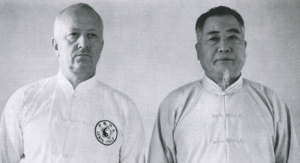 Leader in an important Italian chemical enterprise, Fassi published many best-sellers among the Italian landscape of martial arts-books, he was columnist in respected magazines of the sector, but most of all Roberto Fassi was one of the most renowned Italian masters of martial arts and one of the European pioneers of Karate, Kobudo, Kung Fu Shaolin and T’ai Chi Ch’üan.
Pupil of Master Chang Dsu Yao, Master Fassi won the first place in Honolulu-Kung Fu-world-championship in 1980, in the competition of T’ai Chi forms without weapons. In 1991 Master Chang Dsu Yao conferred him the qualification of sixth Chieh of Shaolin Ch’üan and T’ai Chi Ch’üan: the highest degree ever conferred to a Westerner before.
I had the fortune to participate to his workshops three times in my life: in 1996, in 2002 and in 2008.
My…
View original post 516 more words
Primordial Inflation and BICEP2 results
March 17th 2014 has been a historical date for all of us cosmologists: the BICEP2 experiment results seem to provide evidence for both gravitational waves and the inflationary expansion of the early Universe (even though the observed tensor-to-scalar ratio r = 0.20 at 1σ is in tension with the upper bound r<0.11 at 95% C.L. given by a combination of data from Planck, SPT, ACT and WMAP).
But what is cosmological inflation? As I write extensively in my PhD thesis, it was an accelerated (read: exponential) expansion of the Universe, which occurred right after the Big Bang explosion. It lasted from 10−36 seconds after the Big Bang to sometime between 10−33 and 10−32 seconds (even though r=0.2 now indicates that inflation began even earlier than that).
The theory of inflation was originally proposed in 1980 by Alan Guth and by Katsuhiko Sato, as a mechanism for solving some technical problems of the previous Big Bang theory (the so-called “standard Big Bang scenario”), which didn’t assume an accelerated expansion.
This first version of inflation was anyway predicting a too granular Universe, and still needed adjustments. This problem was solved in 1982 by Andrei Linde, and independently by Andreas Albrecht and Paul Steinhardt, in a revised version
that is now called new inflation. The basic idea is that inflation occurred by a scalar field (i.e. a particle) rolling down a potential energy hill. This particle is called the inflaton: it made the Universe expand fast and then, at the end of inflation, it disappeared decaying into the particle spectrum observed today, namely into the stars, galaxies, dark matter…and us 🙂
Most of my past and present work is devoted to this particle production mechanism indeed. I study how the particle spectrum was generated, according to different theories postulating a specific candidate to become this mysterious “inflaton”.
Professors Andrei Linde and Renata Kallosh get acknowledged of the discovery:
I won’t discuss the theory and the discovery any further, I just paste here links to internet sources which discuss these topics:
Inflation:
My PhD thesis http://arxiv.org/abs/1002.2835
Wikipedia: http://en.wikipedia.org/wiki/Inflation_(cosmology)
The BICEP2 paper: http://arxiv.org/abs/1403.3985
Cosmology discussions:
http://www.scientificamerican.com/article/gravity-waves-cmb-b-mode-polarization/
http://trenchesofdiscovery.blogspot.fi/
As a last remark, I can say that one thing is certain: after the 2012 detection of the Higgs boson, the 2013 Planck satellite results and this latest discovery of gravitational waves and experimental proof of inflation, we are all definitely living exciting times!
A nice trick to lower the volume of your Laney VH100R
I’ll never be grateful enough to the guy who wrote this great tip in some forum (I can’t remember where, unfortunately). I really like my Laney VH100R, it has a wonderful sound in my opinion. And I enjoy the separate FX loops per each channel, that’s just brilliant.
However, as we all know, the Laney is a LOUD amp. So loud that in a typical live situation in a small club it’s basically impossible to play it with volume past 2-3/10. Which I find utterly annoying, as the power tubes don’t get saturated this way and you basically don’t really use them.
So one would like to be able to control the output of this beast, to set the Volume knobs past those ridiculous values, without taking out power tubes or using attenuators.
And here is the trick: in the rear panel there’s a general FX loop, called “Insert”. Now set the switch to Insert (the middle position): the knob right next to it (called “Return level”) will now control the overall volume of the amp directly from the preamp 🙂
This means that the power tubes really need to be pushed more in order to give the same volume! So you get saturation even at bedroom levels 😀
As I wrote at the beginning, I’ll never be grateful enough to that guy, this is just brilliant!
About Quantum Prana, my logo and particle cosmology
My logo certainly carries my initials, however there’s a bit more meaning in it.
As you know from my Home page, I am a theoretical physicist, and I got my PhD at the University of Helsinki in 2010. More specifically, my field was particle cosmology with topic supersymmetric dark matter and supergravity. My papers and theses are found here.
Since I am a certified nerd, it is now clear why I use the name Quantum Prana: quantum physics, though still controversial, provides the basics for most of the physics of the last 100 years. Prana is the Sanskrit word for “life force”, which can be thought as “energy”. Thus Quantum Prana is the quantum energy which “surrounds us and penetrates us; it binds the galaxy together.” (cit.)
This is also the reason why I am called the Dark Matter Guitar 🙂
Related to that, my logo carries the q and p letters in lower case: in mathematics, they are the action-angle coordinates upon which ALL of quantum mechanics (and by extension, quantum field theory) is founded. In fact, by using Hamiltonian mechanics the pair (q,p) describes the quantum states, where q(t) is the position and p(t) is the momentum of the particle.
Starting from q and p, you get all the theory, including cool stuff like the Heisenberg indetermination principle, the Pauli exclusion principle, Schrödinger’s cats and so on.
And on top of that, I also think the symmetry of q p looks cool! 😀
Martial application of the kata Bassai Dai
I include here my theory assignment for the I Dan exam, back in 2005 when I was practicing karate. It contains my own descriptions and explanations of the various actions used in the form (“kata” in Japanese) Bassai Dai. This is one of the most famous kata in the Shotokan style (read my essay in the page Martial Arts for my concept of karate “styles”).
This is the original version in Italian, so those who are not familiar with my mother language can request an English translation by replying to this post 🙂
 Quantum Prana - The Dark Matter Guitar